Translate

Showing posts with label Analysis. Show all posts

Monday, June 15, 2015

Kids These Days

(Heads up, this post isn't really about fandoms, sorry. But I suspect it applies to most of my readers, and I feel like it needs to be said.) I was inspired to write this post by a play I found on AO3 called "#kidsthesedays" (click here to read the play or here to go to the author's tumblr. Tell her vortexofdeduction sent you.) You should definitely read the play, but all the same, I'll give you a basic summary. The play shows that times and situations change, but one thing remains constant: parents complain about "kids these days" and their "crazy" obsessions, activism, etc. The truth is, it's not kids these days, it's kids all the time. Also, we aren't just kids, we are the people who have to live with previous generations' mistakes. We are the ones who will change the world. And it's about time we did.

I can't tell you how frustrated I am when someone criticizes me for using an iphone or going on the internet or complains about how addicted to technology "this generation" is. Technology is a great thing, and it's perfectly acceptable to use it a lot; every generation has adapted to new technology and new information, but it's the older generations who complain because they refuse to see the world as different from the way it was when they were kids. Technology is great; it's provided us with information, communication... much more than just "stupid games".

A while ago there was a photoset going around on tumblr called "#this generation". It made me angry because it's the exact argument I've just been railing against. However, tumblr responded. I now show you a combination of the originals and the responses.
This Generation: WhatsApp Vs Books

This Generation: Cyber Date, Cyber Smooch
That's just a few, but you can find more at http://ifunny.co/fun/6nBstAIp2

I don't know about you guys, but I know that I have a voice and I'm not afraid to use it. I am not just a kid. I am a strong, independent young woman who will fight for justice and equality. You can blame me, pretend I'm just a harmless little girl who cares about fandoms and spends all her time on the internet and will never do anything worthwhile, but I don't care. I exist and act regardless of your opinion. I hope each one of you is willing to stand up for yourself and others.

Saturday, January 10, 2015

"Strong Female" or Well-Written Female?

Gah! Enough with the "strong female"s already! When we say we want a strong female character, we mean we want a well-written, in-depth character who is independent and has lots of great personality traits but also weaknesses like any human (or non-human life-form, as the case may be) - NOT a physically strong "badass" character with no development beyond that! Seriously! So much frustration! But I have to get this rant out.

Unsurprisingly, I'm not the first person to get upset about this particular trend. +Emily Ecrivaine has also written a post about it. I recommend that you check it out, but as great as that post is, I also want to weigh in on the issue, hence this post.

I'm gonna say this right now: just because a character is strong and tough and smart and independent does not mean she is a good character (I'm talking about good/bad, not good/evil). It's like Hollywood has gone too far in the opposite direction from the weak, stupid, careless girls it's portrayed in the past (those are no good, either, just to be clear).

It's time to meet in the middle. A good character needs strengths and weaknesses; leaving one out is like drawing a person really beautiful and detailed - but leaving out an entire half. You need them both to complement each other, else you get a 2-dimensional character that leaves your readers/viewers upset (and writing rants like this).

Now that I've said 2-dimensional, the mathematician in me wants to make this analogy accurate. So what do I mean by 2-dimensional? Well, let's say the first dimension is appearance (and all the other stuff you notice at first glance/description). Thankfully, most writers (I say most, not all) are able to go a bit deeper than that. The second dimension is strengths, the third dimension is weaknesses, and the fourth dimension (yes, I'm adding a fourth dimension) is character development. Unlike physical dimensions (height, width, volume), character dimensions aren't in a specific order. If your character has an appearance and strengths, he/she is 2-dimensional. If your character has an appearance and weaknesses, he/she is also 2-dimensional. If your character has an appearance, strengths, weaknesses, and character development, he/she is 4-dimensional. (Note: I said there isn't any order, but it's kind of hard to have character development without strengths and weaknesses.)

Got that? You need several different elements to make a character. You can't just slap a vaguely defined personality and a story arc on them and call it good. I mean, think about it: you're creating a person. If people were as bad as some characters, we would have a very boring world. And if you're going to make a work of fiction, why would you make such bad characters? Why would you create a boring world when you could create an awesome one? Why put so little work into a character when you could make somebody amazing?

There's not much I can do about, say, Moffat's writing, but I can make sure that the characters I create are real (no, I don't mean they really exist; I mean realistic), and I can ask you to do the same. Let's make the world of fiction a better place.
------------------------------
Coming back to this, I realize I should have included some examples of 2-dimensional characters, so here you are:

Rose Tyler (Doctor Who)
(Check out +Emily Ecrivaine's post about her dislike of Rose.)
What she has: appearance, weaknesses
What I think of her: she just stands around and waits for the Doctor to help her. She's not that smart, and she's not particularly strong. I don't see any significant strengths in her (she has compassion, but so do pretty much all the companions). She whines too much, and she always wanders off and disobeys direct orders (not that she's the only one to do so). She's extremely selfish and jealous. And she's presented as the best companion, the Doctor's love... no. Just no. 

(I'll come back to this later, but someone else needs the computer. I will provide more examples, don't worry!)

Friday, December 12, 2014

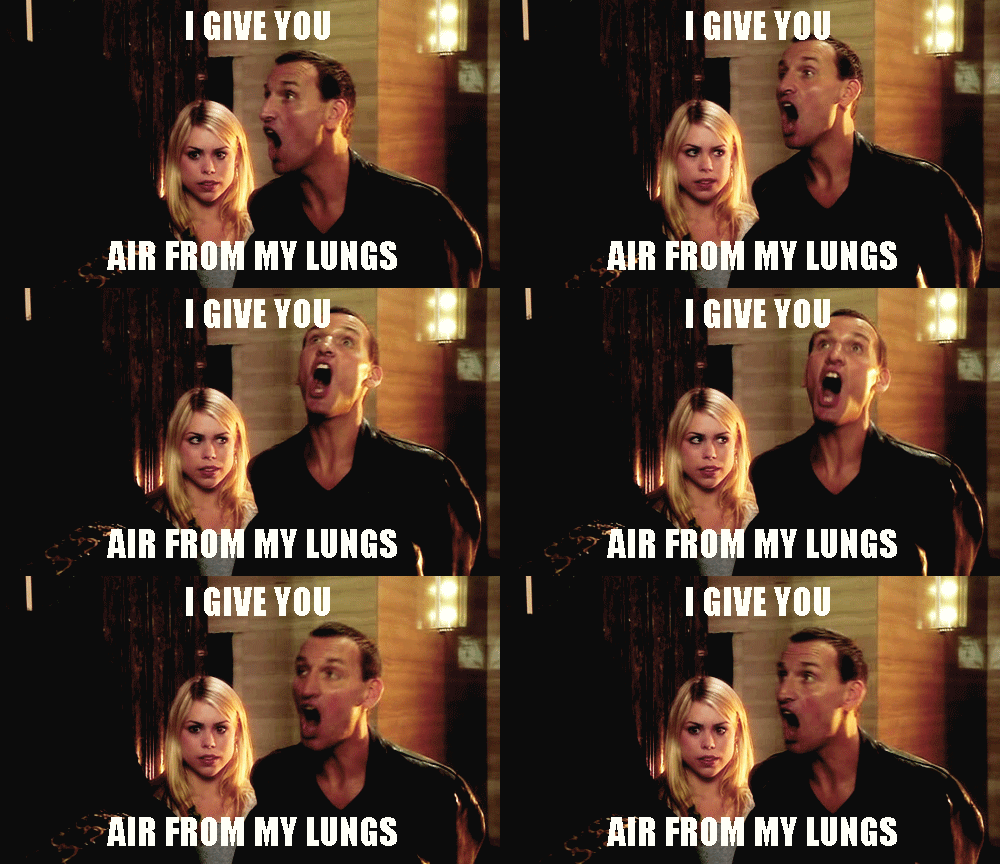
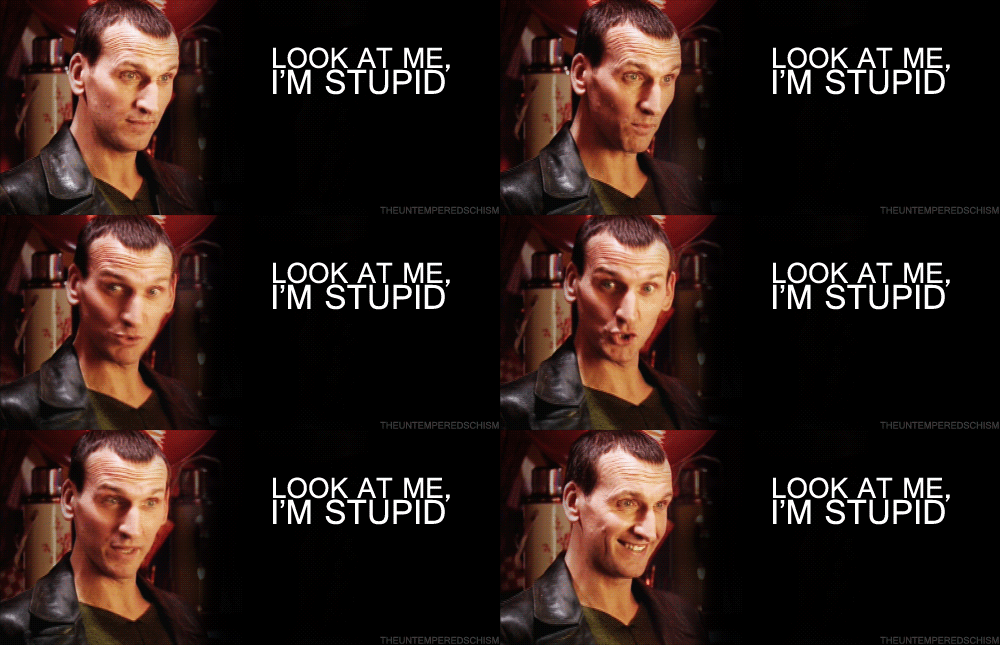
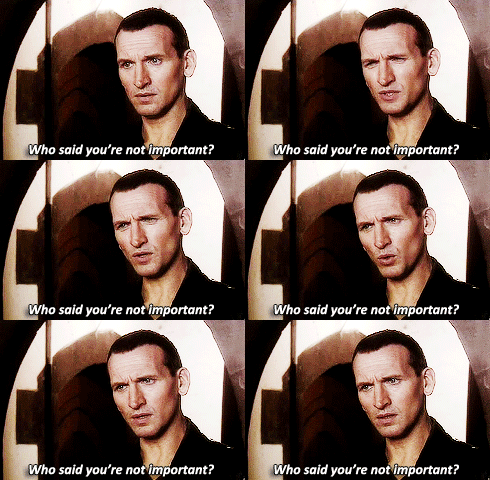
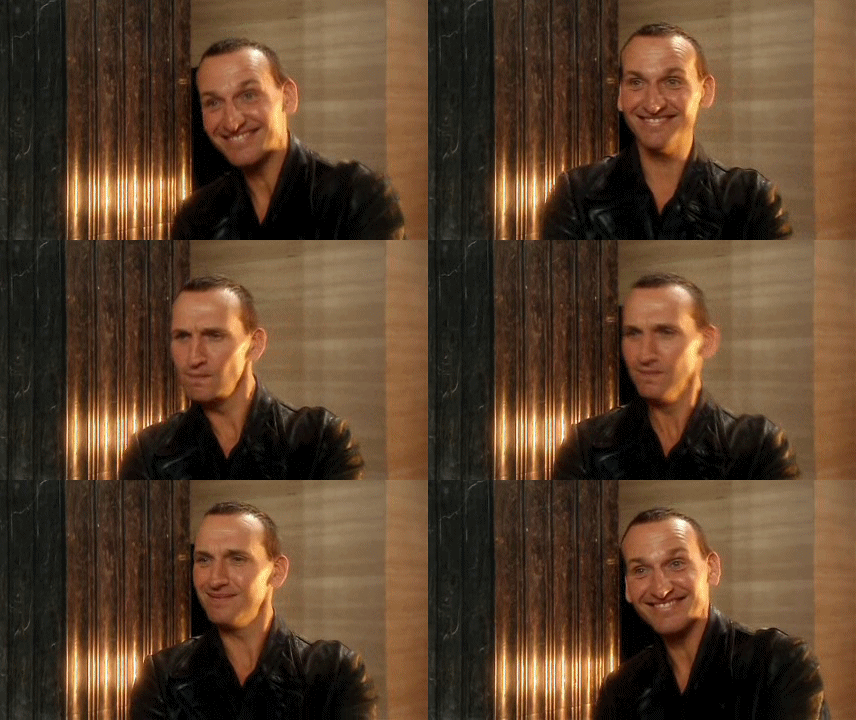
9 Reasons Not To Skip Nine


Hello, Whovians! As you all (hopefully) know, it's a solemn rule not to skip Nine. I must confess, I actually started with Ten, and it wasn't until the middle of Season 5 when I went back to see Nine. I have not regretted that decision. Some people think Nine isn't as good as the other Doctors, but I think he's fantastic! If you skip him, you're really missing out. To make sure I covered everything, I rewatched all of Season 1, basking in Nine's greatness. Here's what you're missing out on:
  1. His cheeky, sarcastic personality 
     
  2. His ridiculousness 
     
     
  3. His smile 


  4. "Fantastic!" 
     
  5. His anger 
  6. His determination 
  7. His MacGyver-type solutions 
     
  8. His way of empowering people 
  9. His dancing 
     
So, that shows you why the Ninth Doctor is absolutely fantastic. I really hope you take the time to watch (or rewatch) Season 1 so that you can see his awesomeness. I really miss him, and I wish he could have got another season or two.

What are your thoughts? Did you watch Nine, or did you skip him? Do you like him? I certainly do, and I hope you can all appreciate him, too.

Friday, December 5, 2014

Lightsaber vs. Sonic Screwdriver: The Use of Weapons/Tools In Fandoms

In every good fandom, there comes a time where there is a need for a weapon or a tool. But which one to use? This post examines various fictional and real weapons and tools used in fandoms.


  1. Lightsabers (Star Wars): like a sword, but with light. The "light" is formed of plasma. The lightsaber is dangerous and difficult to wield, but in the hands of a Jedi, it's a formidable weapon. See this post for more information about lightsabers. Coolness rating: 10/10. Dangerousness rating: 10/10. Usefulness rating: 8/10.
  2. Sonic Screwdriver (Doctor Who): like a screwdriver, but a bit more sonic. When the button is pressed, it emits a light and a buzzing sound. It can't wound, maim, or kill, but it is a useful tool. It can unlock doors, intercept signals, operating machinery and computers, and many other things (as listed on the TARDIS wiki). However, it doesn't do wood. See this post on what I would do if I had a sonic screwdriver. Coolness rating: 9/10. Dangerousness rating: 5/10. Usefulness rating: 10/10.
  3. Gandalf's Staff (The Lord of the Rings): a staff used by Gandalf for casting spells. "You shall not pass!" Coolness rating: 8/10. Dangerousness rating: 9/10. Usefulness rating: 9/10.
  4. Andúril (The Lord of the Rings): the sword used by Aragorn. It was broken into 6 parts, but then it was reforged. Coolness rating: 7/10. Dangerousness rating: 8/10. Usefulness rating: 7/10.
  5. Sting (The Hobbit, The Lord of the Rings): Bilbo finds this sword that glows blue when Orcs are near. (We discover later that it's actually more of a letter-opener because it's so small.) He puts it to good use, then gives it to his son, Frodo. Coolness rating: 6/10. Dangerousness rating: 8/10. Usefulness rating: 8/10.
  6. Mjölnir (Thor): Thor's hammer. Very good at smashing things. Can only be held by those who are worthy. Coolness rating: 8/10. Dangerousness rating: 9/10. Usefulness rating: 9/10.
  7. Phaser (Star Trek): like a stun gun, but more powerful. Can stun, heat, kill, or disintegrate living creatures. It can also damage shields and cut through walls. Coolness rating: 6/10. Dangerousness rating: 8/10. Usefulness rating: 10/10.
  8. The Neuralizer (Men In Black): slightly larger than a pen, this device wipes a person's memory for as long an amount of time as the user chooses with just a flash of light. Afterwards, the people who were affected are highly susceptible to suggestion. Coolness rating: 9/10. Dangerousness rating: 8/10. Usefulness rating: 9/10.
  9. The Point-of-View Gun (The Hitchhiker's Guide to the Galaxy): when fired, this weapon forces anyone in its path to understand and reveal the shooter's thoughts. Coolness rating: 8/10. Dangerousness rating: 4/10. Usefulness rating: 8/10.
  10. Blue Shell (Mario Kart): a bomb that explodes on whoever is in first place, taking out them and anyone else in the vicinity. This slows them down enough that you have a chance of getting ahead. Coolness rating: 5/10. Dangerousness rating: 8/10. Usefulness rating: 8/10.

Saturday, November 15, 2014

What Makes A Good Companion

So, as you may have figured out, I've hit a bit of writer's block in the fanfic I'm currently writing. (If you'd like to help me, just comment on this post, tag me in a google+ post to talk about it, or send me an ask on tumblr at vortexofdeduction.tumblr.com In the meantime, I bring you another blog post.

Today I'd like to talk about Doctor Who companions and what makes for a good companion (are you listening, Moffat?)

Not falling in love with the Doctor - one of the things that frustrates me (and many other viewers, I'm sure) is that it seems like almost every female character falls in love with the Doctor. Of the six female companions in New Who (well technically, River is more than a companion), Donna is the only one who does not love the Doctor. Rose and the Doctor both love eachother, which is sweet and all, but sometimes I feel like the romance gets in the way of Rose's character development. Martha is a great companion, but she's so busy being a lovesick puppy that she can't realize her full potential until she leaves the Doctor. Donna hates the Doctor at first, and then they become friends (and they are definitely not a couple, as the running gag goes). Amy flirts with the Doctor shamelessly in Season 5, and then the Doctor reminds her that she has a fiancé and brings him back, so that romance is short lived. Clara sort of kind of flirts with the Doctor, and they have a sort of ambiguous love-hate relationship, which I really hate. Even when Danny comes in, she still spends large amounts of time with the Doctor.

Having a life outside of the Doctor - as much as I dislike Clara, I do like that she has a life outside of the Doctor. She doesn't spend all of her time with him. She has a job teaching and, later, a boyfriend. Of course, she isn't the only one to have another life. Jack works at Torchwood, running it in the Doctor's honor. Martha's life sort of goes on hold when she travels with the Doctor, but after she leaves, she goes on to do many things, first working for Torchwood and UNIT, then later going freelance (click here to see her full profile on the TARDIS wiki). Similar to Martha, Donna has a life before and after the Doctor, but not so much during her travels with him. Rory has a life outside of the Doctor, but Amy doesn't.

Not being defined by a story arc - several companions have a main "story arc" to explain why they are with the Doctor or how they interact with him. Far too many times, a story arc becomes the defining point of a character, and the character is two-dimensional as a result. Rose was just a regular person, no story arc or anything. Martha, too, traveled with the Doctor only because she wanted to. Donna had a story arc (the most important woman in the universe, the Doctor-Donna), but it was written such that we didn't really notice it until the Season 4 finale, and then we were just like "Oh! So that's what was up with all those little coincidences!" Then Moffat took over, decided he liked the companion story-arc idea, and WRECKED it. Amy is a great character, but the whole "girl who waited, can bring people back from non-existence, crack-in-her-bedroom-wall" thing is a bit excessive. It makes her less real in my opinion. And Rory? There are so many great things to be said about Rory, but the first thing that comes to mind is "the guy who died way too many times". He's much more than that, obviously, but he will forever be remembered as the guy who kept dying and coming back. And don't even get me started on Clara as the Impossible Girl.

Skills and talents - apart from unrealistic powers (e.g., coming back from the dead), I really like it when companions are able to help the Doctor out. Rose doesn't start out with much (except for her strength of body and will, as we see in the first episode), but she quickly learns from the Doctor and is able to help him. Martha has extensive medical knowledge, and she too learns from the Doctor. Donna has super-temp skills as well as a good amount of intelligence and great reasoning skills. Amy starts out with the same skill-set as Rose, essentially. Rory has nurse skills. Clara has bossiness, if you want to call that a skill.

BAMF - pretty much all the companions have at least one BAMF moment, but some are BAMFs more than others. Rose is pretty tough; you don't want to mess with her. Martha is normally gentle and helpful, but she knows when to step it up and go into BAMF mode and save the world. Donna is pretty much always on BAMF mode. Amy doesn't really go into full BAMF mode much, but she's tough and bossy. Rory, like Martha, stays calm until the right moment, then he unleashes his fury: "Demons run when a good man goes to war." Clara knows when to be a bossy-pants and take over the situation.

Anything you think I missed? Let me know what you think.

Tuesday, October 21, 2014

A Change Of Heart

You know how sometimes you see a character (or if you're reading a book, read about a character), and at first you hate them, but then they grow on you until you absolutely adore them? Yeah, that's happened to me too, and it's what I'd like to discuss today.

First impressions can be misleading. In many cases, you think a character is awful, but then you see that they are good. The question is, did the character develop, did the writing get better, or did you simply come to view the character in a different light? I'd like to share with you a few examples of characters that I disliked at first, but now appreciate. 

Martha Jones (Freema Agyeman)
Fandom: Doctor Who
Reason for initial dislike: she was hopelessly in love with the Doctor. And unlike Rose, her feelings weren't reciprocated, so instead of "look at this cute couple", it was more like "look at this poor lovesick puppy". 
Type of change: character development, change of heart
Why I changed my mind: I didn't really like Martha until the last few episodes of series 3, when she proved herself to be independent, intelligent, and highly competent.

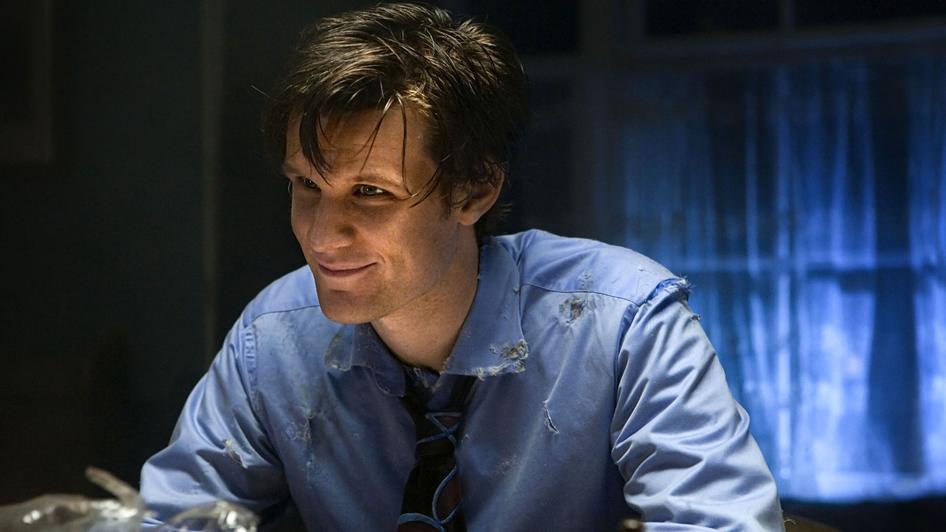
The Eleventh Doctor (Matt Smith)
Fandom: Doctor Who
Reason for initial dislike: he wasn't the Tenth Doctor. Also, I got mad at him for leaving Amelia Pond - twice!
What type of change: character development and a change of heart. The writing stayed about the same. 
Why I changed my mind: As the season progressed, I began to see that though Eleven was different, he was his own unique person to be celebrated. I saw his kindness and compassion, his playfulness, and all his other great attributes. At some point, I decided he was almost as good as Ten. And now I miss him.

Danny Pink (Samuel Anderson)

Fandom: Doctor Who
Reason for initial dislike: I don't approve of random love interests thrown into a story, and that's how I saw Danny at first. I was mad at Moffat for bringing him in; one companion is enough, and Clara was too preoccupied with the Doctor to take on a boyfriend. 
Type of change: character development, better writing, change of heart
Why I changed my mind: I was really worried Danny was going to be a poorly written character, but it turned out that Moffat actually did a good job with Danny (unlike some other characters... *cough cough* Clara *cough cough* Twelve). He reminds me a little of Mickey and a little of Rory, but he's different from both of them. He's really accepting and supportive of Clara, even to the point that he allows her to continue traveling with the Doctor. And he has a fierce loyalty towards Clara, doing everything he can to help her. 

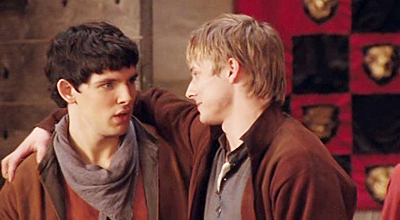
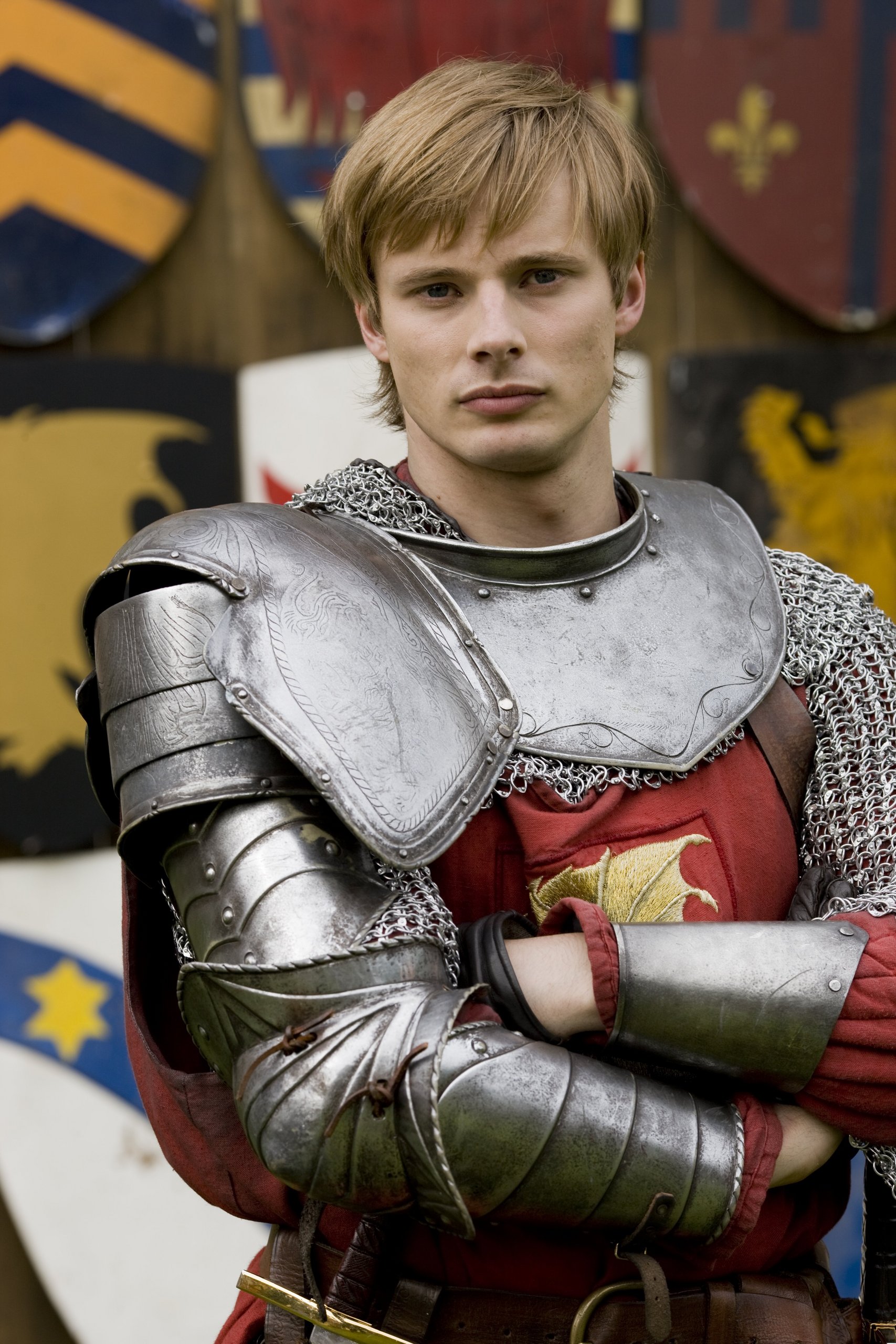
Arthur Pendragon (Bradley James)
Fandom: Merlin
Reason for initial dislike: I agree with Merlin in episode 1 that Arthur is a royal prat. And an arrogant one, too. He's rude and disrespectful, and he expects everyone to do his will. He barely seems to care about others. 
Type of change: lots and lots of character development. Maybe a change of heart, too. 
Why I changed my mind: As the show progressed, I saw how Merlin began to change Arthur into a better person. I saw that Arthur really cares about his people, and that he will risk his life for that of a servant. He may still be a prat sometimes, but he has a heart of gold. 

Uther Pendragon (Anthony Head)
Fandom: Merlin
Reason for initial dislike: he outlaws magic and executes sorcerers without a second thought, believing that all magic is evil. Even in things not related to magic, he is ruthless. He rules the kingdom with an iron fist. 
Type of change: change of heart
Why I changed my mind: as Emily Ecrivaine at Emily Ecrivaine Reviews pointed out in this post, he's only doing what he thinks is best for the kingdom. Though he is a cruel, disillusioned man, his intentions are pure; he truly has Camelot's best interests at heart. I can't say I like him, but I can at least respect him.

Philip Anderson (Jonathan Aris)
Fandom: Sherlock
Reason for initial dislike: the way Anderson's written, we're supposed to dislike him. He apparently lowers the IQ of the whole street just by talking. He's really annoying and not that bright.
Type of change: change of heart, possibly character development
Why I changed my mind: again, to go too much in depth would be to give away spoilers. Let it suffice to say that Anderson is smarter, kinder, and better than we give him credit for. (For this change of heart, I have Emily Ecrivaine to thank again - this is the post that made me rethink my perspective on him.)

I'd also like to point out that this principle applies to ships as well. The more I see of a ship, the more logical it seems. So now, a few ships that I've come to like.

Johnlock (Sherlock Holmes and John Watson)
Fandom: Sherlock
Reason for initial dislike: I'm not homosexual, and I'm a little hesitant to go along with a gay ship as a result. (Update: I used to be like that. Now, I ship same-sex couples without a second thought.) Also, it's not canon.
How much I ship them now: they're not my OTP or anything, but I definitely read Johnlock fanfiction and I think about Johnlock sometimes.
Why I changed my mind: it's clear they care about each other a lot, and it seems like they are attracted to each other. It's as if they like each other, but don't dare admit it.

Merthur (Merlin (Emrys) and Arthur Pendragon)
Fandom: Merlin
Reason for initial dislike: same reason as for Johnlock. Also, I initially shipped Merlin with Gwen. And then when Gwen got together with Arthur, I shipped Merlin with Morgana - until she went bad.
How much I ship them now: OTP!
Why I changed my mind: they're just so perfect for each other! They complete each other. And each of them would die for the other. They share a close bond (or, as the dragon might call it, destiny).

The Doctor and Rose (both Nine/Rose and Ten/Rose)
Fandom: Doctor Who
Reason for initial dislike: I didn't like Rose that much at first (yeah, I know she's not in my list of characters above. That's because I still don't like her that much. It's more like I went from dislike to neutrality.) I didn't think the Doctor should have any romantic attachments.
How much I ship them now: Meh. I kind of ship them. I'll read fanfiction with this ship, but I don't seek it out like I would for some of my other ships (including Johnlock and Merthur).
Why I changed my mind: Idk, I think they're kind of cute together. Also, Rose makes the Doctor a better person.

Sunday, October 5, 2014

Arrogance

Now listen up, you lot: I've got a great blog post all written up, so you better drop everything and read it, basking in my awesomeness because I am the best blog writer ever!

Thankfully, I don't normally talk (or write) like that. That was an example of arrogance, which is what I'd like to discuss today. It's a character trait that seems to be quite prevalent in many TV/movie protagonists. Just to be clear, let's define that term. Arrogance is "offensive display of superiority or self-importance; overbearing pride". 

So who's arrogant? Well, I've got a few characters in mind. Let's look at each of them in turn. 

Arthur Pendragon- Merlin
As Merlin loves to point out, Arthur is a selfish, arrogant prat. It's not that he tries to be, it's just that because he's a prince, Arthur is used to being above everyone else (except for Uther, whose example of arrogance and rudeness he follows). Arthur is incapable of showing politeness or respect. Enter Merlin. When not busy saving his life, Merlin helps Arthur become a better person. 

Sherlock Holmes- Sherlock
Sherlock is insufferably arrogant, and it's easy to see why. Because he's such a genius, he assumes that other people are all idiots (which, comparatively, they are). He has no social skills, and his constant rudeness is enough to drive anyone mad. If it weren't for the fact that Sherlock's intelligence is sorely needed by Scotland Yard, they would likely have told him to stop consulting a long time ago. 

The Doctor- Doctor Who
The Doctor's arrogance stems from the fact that he is not human. The very name "Time Lord" suggests pompousness and arrogance. The Doctor assumes that he's better than everyone else simply because he has two hearts and can regenerate. He thinks he the smartest person in the room, even though that's not always the case. In his defense, though, he does think everyone is important, he just thinks he's most qualified to be in charge and everyone should do as he says. 

Sheldon Cooper- The Big Bang Theory
Though he may be a great scientist, I would not want Sheldon as my roommate. His lengthy "roommate agreement" contracts are unfair and a violation of normal rights and rules. He constantly belittles people, insisting that because he is better (which he isn't always), other people are worthless. All of this because, like Sherlock, he has no social skills whatsoever. However smart he may be, Sheldon is an arrogant jerk. 

So, we've got a few examples of arrogant protagonists. Now what? Well, the time has come for more questions. 

Why are so many protagonists arrogant?
I think the main reason is that most protagonists are incredibly smart and talented, which naturally leads to an inflated ego (i.e., arrogance). This doesn't happen to all talented characters, and not every protagonist is talented, but it's still true that talent and arrogance, which often go hand in hand, are important parts of many main characters. 

Are arrogant characters total jerks?
No, most of them have good qualities inside. Arthur has a fierce loyalty to Camelot and will do anything to defend it and its subjects, even down to the lowly servant. Sherlock has a great deal of emotions, he just never shows them. He uses his intelligence to help the police. The Doctor saves the universe. And Sheldon... well, he's a great scientist. 

So should we forgive characters for their arrogance?
No. They're still annoying and rude, and there's no reason to dismiss that. All I'm saying is that you don't have to hate them. You can still be annoyed by them and berate them, though. 

Is there any hope for these characters to be less arrogant?
Yes, thankfully. In many cases where there is a selfish, arrogant character, there is another, kinder character who helps the arrongant character to see reason and change his/her ways. Arthur has Merlin. Sherlock has John. The Doctor has his companions (currently, Clara). And Sheldon has... Leonard? I don't know, maybe he doesn't fit this pattern as well as the others. 

And that's about all I can think of on the subject. Let me know if you think I missed anyone or anything. Thanks for reading!

Monday, September 1, 2014

Doctor Who? (New Who)

Hi, everyone! I realize that I haven't exactly been consistent about blogging in these past few weeks. What happened, you ask?
The timey-wimey stuff consisted mostly of marching band and summer homework. But now that I've got a break in between band camp and school, and I've also finished all my summer homework, I've got some time to blog again! Yay! And thanks for continuing to read my blog, even when I don't post very often.

Okay, enough exposition. Today's topic: The Doctor. Specifically, the War Doctor and the 9th-12th Doctors, as I haven't seen much of Classic Who. They're all the Doctor, but each incarnation has his own unique personality. What sets them apart? Let's take a look at each of them in turn.
The War Doctor (8.5), played by John Hurt
What he did, he did without choice. In the name of peace and sanity, but not in the name of the Doctor. The War Doctor is pretty different from the other Doctors in that he had some control over who he was. In "The Night of the Doctor", we see the Eighth Doctor, desperate amidst the Time War, take a potion to turn himself into a warrior. That warrior is the Time Lord we call the War Doctor. He is full of pain, anger, and fear, but he also carries a great deal of responsibility with him, feeling that the Time War must end and he must be the one to stop it. After killing all the Time Lords and Daleks (at least, that's what he thought he did), he is filled with guilt, sadness, and possibly regret. He is probably the most unhappy Doctor of all of them, and for most of the time, he isn't even called the Doctor. Nevertheless, he is important, and without his act of bravery, Gallifrey would have fallen.

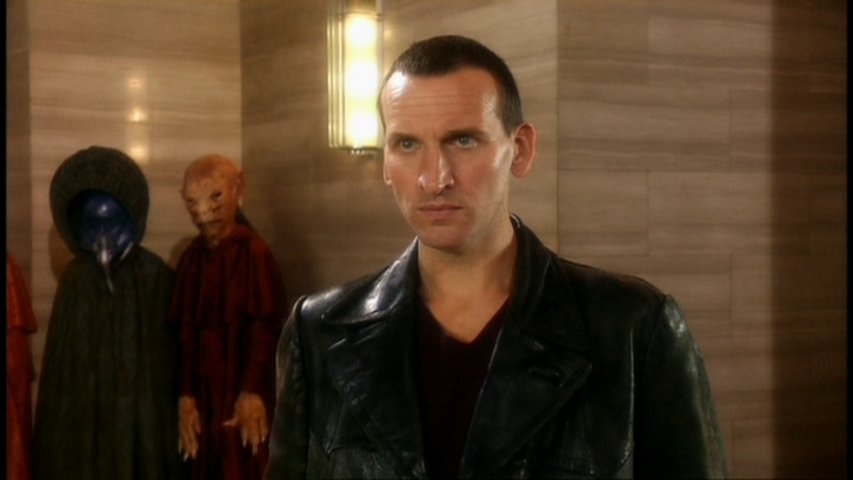
The Ninth Doctor, played by Christopher Eccleston
Fresh from the Time War, he is still filled with anger and regret. Over the course of season 1, we see as the Doctor shows kindness and is friendly to those he takes a liking to. Rose changes him from a distant, angry alien to a human being. Well, more like a human being anyway. Though he can be dark, angry, and fierce, he tries not to go too far. And though he may seem like he's a killer, he'd rather be a coward, any day.
Appears in:  Season 1

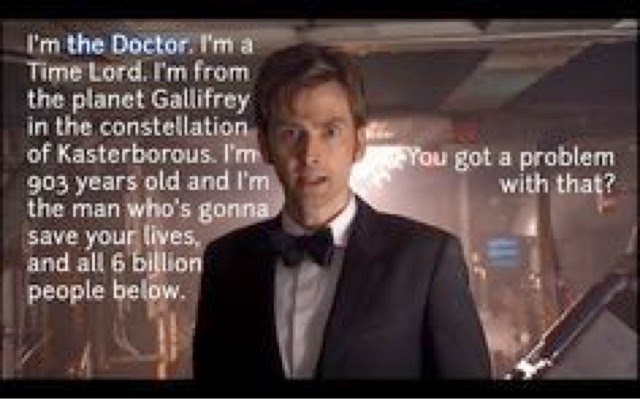
The Tenth Doctor, played by David Tennant
By this time, the Doctor has moved on enough that he isn't constantly showing anger and bitterness. The Tenth Doctor is cheerful and friendly, even flirtatious. At any rate, he certainly is popular with the ladies (and Jack, too, for that matter). Despite his pleasant appearance, though, he is not a man to be messed with. In the face of danger, the Tenth Doctor transforms into a hero and saves the day. Especially later in his life and when he's traveling by himself, he gains a sort of righteous fury, and right from the beginning, we see that he does not give second chances. And through all of this, he is the man who regrets. Though he's happier and more friendly than 8.5 and 9, he is still full of sorrow and regret, and he never forgets Gallifrey.
Appears in:  Season 2Season 3Season 4The Next DoctorThe Waters of MarsThe End of Time, Pt. 1The End of Time, Pt. 2The Day of the Doctor

The Eleventh Doctor, played by Matt Smith
At this point, he's become the man who forgets. He is the youngest incarnation of the Doctor (by "youngest", I mean Matt Smith is the youngest actor to play the Doctor. The youngest Doctor is, of course, the First Doctor.), and we can see that in his personality, as he is filled with childlike silliness and a fascination with the universe. However, he wouldn't be the Doctor without a dark side to his personality. By this point in his life, the Doctor has become too big. People run away from him in fear. Wars are started because of him. This goes against everything the Doctor believes in, so he has to sink back in the shadows for a while, trying to undo the damage he's done.
Appears in: Season 5Season 6, Pts. 1 & 2Season 7, Pt. 1Season 7, Pt. 2The Day of the DoctorThe Time of the Doctor

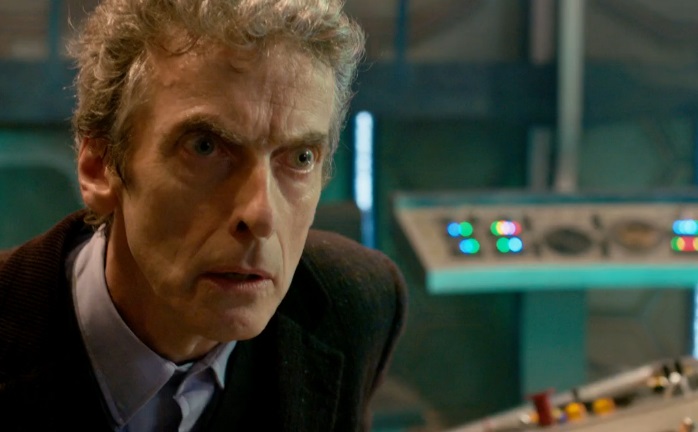
The Twelfth Doctor, played by Peter Capaldi
The Twelfth Doctor shouldn't even have existed. Time Lords only get 12 regenerations, and the Doctor had used up all of them (if you're wondering how that adds up, the regenerations are: 1 to 2, 2 to 3, 3 to 4, 4 to 5, 5 to 6, 6 to 7, 7 to 8, 8 to 8.5, 8.5 to 9, 9 to 10, 10 to tentoo, 10 to 11). However, Clara convinced the other Time Lords to give the Doctor a new regeneration cycle so he could keep going. This new Doctor is much more dark and mysterious than his last few predecessors. He wants to know if he's a good man, and he worries about what sort of person (or rather, Time Lord) he is. He's really strange, but in a good sort of way.
Appears in: Season 8

And that's all I've got on each of the Doctors. If someone knows Classic Who well and would like to write a guest post describing the first 8 Doctors, that would be great (just tag me in a private post on Google+ and we can discuss it). As I'll be pretty busy pretty soon, I don't know when my next post will be, but in the meantime, you're welcome to read old posts. Allons-y!