Translate

Showing posts with label Fandom School (1st period): Canon. Show all posts

Wednesday, June 17, 2015

Fandom School (1st period): Fixing Canon

It's time for Fandom School again! The subject is canon, and, let's be honest: a lot of times, the writers really mess things up.
So, what do you do? Just sit in silence? I think not. Instead, it's time to take matters into your own hands. A while ago I wrote about different types of canon, and I'd like to discuss the types that don't comply with canon. What do you do if you don't like canon? Take Nick Fury's advice; ignore it. Write a fix-it fic and change everything you don't like. Write an AU where the offending event never happened. The possibilities are endless.

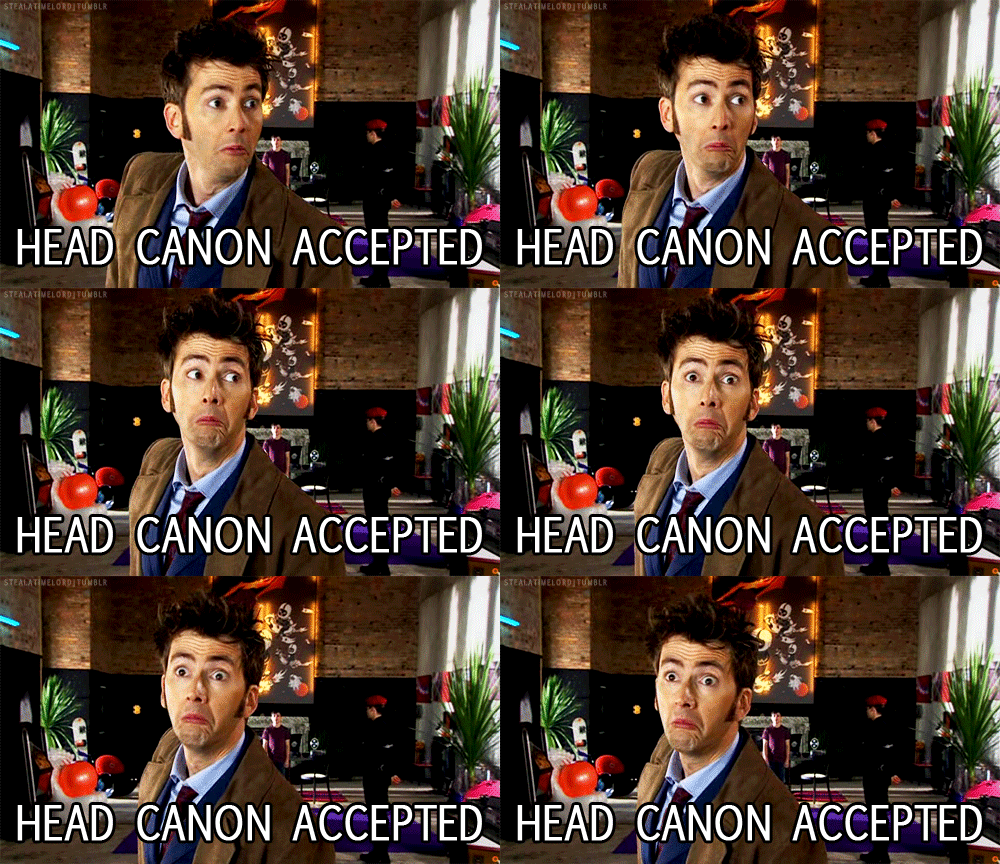
Of course, you don't have to write a fanfic. You can also just come up with headcanons. As I said in my post about headcanons, headcanons don't have to comply with canon. It can just be a case of 

"But I'm perfectly happy with the current canon. Why would I need to change anything?" you might ask. Well first of all, you must not have watched you TV show/movie for very long. And secondly, I'm ahead of you because I've already anticipated this question. Here are a few canon problems you might want to fix.
  • Character death - nobody likes it when their favorite character dies, especially if that death served little purpose.
  • Ships - many fans of BBC Sherlock will argue that John married the wrong person, and so they'll write about Johnlock instead of John/Mary
  • Character development - often times minor characters (sometimes even major characters) don't get much character development, which is a shame, but fanfic writers can easily fix that.
  • Events that should have happened - I think Merlin should have revealed his magic to Arthur much earlier, and a quick search of AO3 shows that many people agree with me and write magic reveal fics
  • Events that shouldn't have happened - for every story that involves betrayal, there will be fanfics in which that character stayed loyal
  • Events that don't make sense - sometimes authors just plain don't explain things, and sometimes the explanations they give are unsatisfactory.
  • Contradictions/continuity errors - these are almost as annoying as spelling and grammar errors, so naturally people want to correct them.
So, what problems in canon would you like to fix?

Wednesday, January 14, 2015

Fandom School (1st period): Fanon

Today is a snow day (even though there is no snow), so I am very happy. Anyway, here's Fandom School. The subject is canon and the topic is fanon.

So what exactly is fanon? Fanon is like canon, except that it's created by the fans and not the original creator. Sometimes fanon conflicts with canon, and sometimes they coincide. Fanon doesn't have to be agreed on by everybody, but it is accepted by the majority of the fandom.

What can be fanon? In many cases, ships are fanon. For example, Johnlock and Merthur are accepted by most fans, even though they are not canon (in fact, Johnlock has canon against it). Events can also be fanon. In the LoTR fandom, it's fanon that Legolas and Aragorn knew each other before The Fellowship of The Ring. The Big Bang Theory has the fanon that Sheldon has Asperger's Syndrome.

What's really exciting is when fanon becomes canon. For example, fans began calling Voldemort "Voldy", which became canon in The Deathly Hallows. And now we know that a Weeping Angel will turn to stone if it sees its own reflection. And in Dilbert, the cat character was unanimously named by fans as Catbert, and creator Scott Adams decided to confirm that.

What examples of fanon do you know of?

Wednesday, November 12, 2014

Fandom School (1st period): Types of Canon

Happy Wednesday, everyone, and welcome to Fandom School! I've already given a brief definition of canon and explained headcanon, so now it's time to talk about the many different types of canon. A quick search on AO3 reveals many different canon-related tags, which will serve well for organization purposes in this post.

Canon Compliant - follows with all parts of canon.

  • Canon Related - specifically related to an event in canon.
  • Canon Universe - takes place in the universe created by the canon.
  • Canon Timeline  - takes place over a range of events during canon. Follows the canon timeline.
  • Pre-Canon - takes place before canon. Think of it as a prequel.
  • Canon Era - takes place during canon (during the span of the book, movie, or TV show)
  • Post-Canon - takes place after canon (after the end of the book/movie; after the series finale)
  • Canon Continuation - same thing as post-canon, but with special care taken to make sure that it fits with canon
  • Canon Dialogue - includes direct quotes from the show/book/movie
  • Could Be Canon - compliant with canon, but not part of it. Think of it as behind the scenes.
  • Canon Crossover - a crossover that attempts to, apart from being a crossover, preserve canon for all fandoms involved


Not Canon Compliant - changes or ignores one or more canon events/characters.

  • Alternate Universe - Canon Divergence - accepts canon up to a certain point, then changes an event and goes from there.
  • Fix-It - corrects something in canon that the author disagrees with.
  • Post-Canon Fix-It - wraps up the loose ends. May be canon-compliant, or may be different enough that it doesn't comply with canon.

Wednesday, July 9, 2014

Fandom School (1st period): Headcanon

Fandom school has now come full-circle, so it's time to revisit the first class in Fandom School: canon. If you haven't read it already, I suggest you go back and check out my first post about canon. Now it's time to talk about something very fun called "headcanon". Headcanon is canon for a particular fandom that is not official, but is technically possible. There are a few types:

1. Headcanon that explains a confusing detail:
For example, *SPOILER ALERT SKIP THIS IF YOU HAVEN'T FINISHED SEASON 2 OF SHERLOCK* how did Sherlock survive the fall?
  • You can believe one of the crazy theories shown at the beginning of season 3 episode 1
  • You can believe what Sherlock tells Anderson
  • You can try to come up with something from this hilarious video (the explanation starts at 2:43):
  • Or, my favorite headcanon is that the Doctor saved Sherlock.

2. Headcanon that explains how an actor from one show/movie appears in another show/movie
For example, Jonathan Aris: how is Anderson in Merlin?
Personally, I think Anderson got touched by a Weeping Angel after The Empty Hearse.

3. Headcanon that is just fun, "behind-the-scenes" sort of stuff
For example...

It should be noted that headcanon is NOT the same thing as canon. Canon is something that explicitly happens in the fandom, and is an accepted fact. Headcanon is something made up by a fan that is accepted as true by one or more fans.

Headcanon has a few levels of plausibility:
1. It is reasonable and even has subtext and various details that could support it, but is still not explicitly shown as canon.
2. It has no evidence for or against it, so it is possible.
3. It would require a significant change in the fictional universe to be plausible (e.g., Narnia doesn't exist in the Tangled universe, but it could)
4. It specifically goes against a canon event (as Adam Savage would say, "I reject your reality and substitute my own.")

No matter what type it is or how plausible it is, headcanon makes the fandom experience a lot more fun.

Wednesday, April 30, 2014

Fandom School Class (1st period): Canon

Hello, dear readers! I noticed that my post "Fandom School" was quite popular, and one person commented "Do it!" Now, I can't actually set up a virtual fandom school (I don't know how), although there are lots of multifandom communities you can join on Google+ (I'm sure there are lots of multifandom Facebook and tumblr groups, too, but I wouldn't know). So, up first (i.e., our first period class) is Canon.

First of all, what is canon?
In general, canon refers to things that are understood to be true according to sources that are accepted. (It also refers to a musical round, but that's not relevant here.) To be a little more specific, there are two types of canon. 

The canon of the church
The church has a few written works that it accepts as canon. This includes the bible, catechisms, and other select works as defined by the denomination. For example, I belong to the Christian Reformed Church (a Protestant denomination of Christianity), which follows the Heidelberg Catechism, the Belgic Confession, and the Canons of Dordt. 

The canon of fandoms
This is the type of canon with which you, my readers, are probably most familiar with. This is determined by what happens in the TV show/movie/book and all related spin-offs (except for fanfiction, which may or may not be canon). It tells what happened and is true, and what didn't and should be ignored. Many people like to ignore the canon in favor of their own ships, fanfiction, etc. 

But more on that next class. I'll see you next week, with our 2nd period class: ships. (Please leave suggestions for classes you'd like to see at fandom school. Thanks!)